Tennis Font Svg and Tennis Alphabet: A Practical Guide for Creators
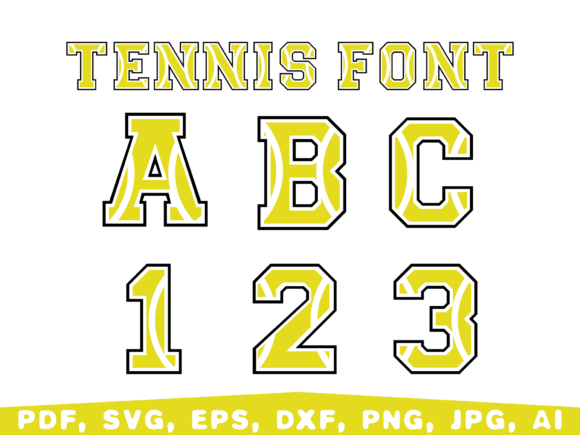
Discover the dynamic Tennis font svg, a versatile graphic composition skillfully crafted for your creative needs. Whether you are designing merchandise for a local club, creating personalized gifts for a tournament, or building a brand identity for an athletic wear line, this specific typographic style offers a unique blend of retro sportiness and modern clarity. The Tennis Alphabet is more than just a collection of letters; it is a design asset that evokes movement, precision, and classic court aesthetics. However, having access to a high-quality design is only the first step. Many creators, from hobbyists to professional marketers, stumble not because the asset is flawed, but because they misunderstand how to leverage its technical and aesthetic properties effectively.
Available in a variety of file formats such as SVG, PNG, PDF, AI, JPG, EPS, and DXF, this unique design is adaptable for diverse applications. Yet, this versatility often leads to decision paralysis or incorrect usage. To ensure your final product looks professional rather than amateurish, it is essential to navigate the common pitfalls associated with sports typography and vector graphics. Let’s explore how to evaluate, select, and apply the Tennis font svg correctly to avoid costly reprints and wasted time.
Understanding File Formats Beyond the Extension
One of the most frequent mistakes creators make is selecting a file format based on familiarity rather than application. While the Tennis font svg package includes multiple options, using a JPG for a vinyl cutter or a rasterized PNG for large-scale banner printing will inevitably lead to poor results. The SVG (Scalable Vector Graphics) format is generally the gold standard for cutting machines like Cricut or Silhouette because it retains mathematical paths that allow for infinite scaling without pixelation. However, not all SVGs are created equal.
Before purchasing or downloading, verify that the SVG is truly vector-based. Some sellers mistakenly label high-resolution PNGs as SVGs, or they provide SVGs where the text has been flattened into a single uneditable shape. If you need to adjust the kerning of the Tennis Alphabet to fit a specific curved surface, like the brim of a cap, a flattened vector will be useless. Always open the file in vector editing software or your cutting machine’s preview mode to confirm that individual letters remain distinct paths. For print-on-demand apparel, the AI or EPS files are often superior if you plan to modify the stroke weight or add distress effects, as these formats preserve layer integrity better than web-optimized SVGs.
Evaluating Legibility and Spacing in Sports Typography
Sports fonts are designed to be bold and impactful, but this characteristic can become a liability if readability is sacrificed for style. A common oversight when using the Tennis Alphabet is underestimating the importance of negative space. On a digital screen, tight letter spacing might look cohesive and energetic. When transferred to fabric via heat transfer vinyl (HTV) or screen printing, those same tight gaps can fill in with adhesive or ink, turning distinct letters into an illegible blob.
To avoid this, always perform a physical test print at the intended size before committing to a full production run. If you are personalizing a baby’s outfit or a small tote bag, the scale is significantly smaller than a standard t-shirt design. At reduced sizes, intricate details in the Tennis font svg may disappear. In these instances, consider increasing the tracking (letter spacing) by 5% to 10% or choosing a simplified variation of the alphabet if available. Remember that fabric texture also affects legibility; a font that reads clearly on smooth polyester may struggle on a textured canvas tote bag. Adjusting your design parameters based on the substrate is a hallmark of professional craftsmanship.
Licensing and Commercial Viability
For entrepreneurs and small business owners, the legal aspect of using the Tennis font svg is just as critical as the visual aspect. A widespread misunderstanding is assuming that purchasing a digital download grants unlimited commercial rights. This is rarely the case. Many designers offer tiered licensing: personal use, small business commercial use, and extended commercial use. Using a personal license to sell hundreds of tennis-themed stickers on Etsy is a violation that can result in shop suspension or legal action.
Always read the license agreement specifically for the Tennis Alphabet you intend to use. Check for restrictions on the number of units sold, whether you can use the font in a logo (which often requires a separate trademark license), and if attribution is required. Furthermore, understand the difference between using the font to create a new design versus reselling the font file itself. You can typically sell a finished t-shirt featuring the Tennis font svg, but you cannot sell the SVG file as a standalone digital product. Clarifying these boundaries upfront protects your business reputation and ensures you are supporting the original creator ethically.
Color Contrast and Application Context
Tennis aesthetics are traditionally associated with white, green, and navy, but modern applications often experiment with vibrant palettes. A practical error occurs when creators rely solely on screen color accuracy. Monitors emit light, making colors appear brighter and more saturated than they will on physical media. A neon yellow Tennis Alphabet that pops against a dark background on your laptop may look washed out or muddy when printed on a cotton shirt.
- Use Pantone References: If possible, match your digital colors to physical Pantone swatches rather than relying on RGB hex codes for print projects.
- Consider the Base Material: White ink on a dark garment requires an underbase layer that can alter the perceived color. Test your color combinations on the actual material you plan to use.
- Avoid Low-Contrast Pairings: Light grey text on a white tote bag may look subtle and elegant digitally but will be invisible in outdoor lighting. Ensure sufficient contrast ratios for accessibility and visibility.
Optimizing for Different Production Methods
The Tennis font svg is marketed as adaptable for t-shirts, stickers, caps, and overlays, but each medium demands specific technical adjustments. Treating them interchangeably is a recipe for frustration. For example, embroidery requires a completely different approach than vinyl cutting. Embroidery machines cannot handle extremely thin lines or tiny serifs often found in stylized tennis alphabets. Attempting to stitch a delicate SVG without digitizing it specifically for thread will result in broken needles and puckered fabric.
If your goal is embroidered merchandise, check if the Tennis Alphabet package includes an embroidery-specific file or a "stitch-friendly" version. If not, budget time or money to have the design professionally digitized. Conversely, for sticker creation, ensure the SVG has closed paths and no overlapping elements that could confuse the cutter. For printable overlays used in social media graphics, the PNG format with a transparent background is usually preferable to SVG, as many social platforms do not support vector rendering. Matching the file type to the manufacturing process saves hours of troubleshooting and ensures the dynamic energy of the design translates faithfully to the final product.
Making an Informed Decision
Before adding the Tennis font svg to your cart or library, take a moment to audit your current project requirements. Ask yourself what the primary end-use is, what equipment you will be using, and whether your current licensing covers your intended scale. Look for previews that show the font applied to real products rather than just flat digital mockups; this provides a realistic expectation of how the Tennis Alphabet behaves in three-dimensional space. By approaching this graphic asset with technical awareness and practical foresight, you move beyond simple decoration and into intentional design. Let your imagination run wild with endless possibilities, but anchor that creativity in informed execution to achieve results that are both visually stunning and professionally sound.