Evaluating the Red Superhero Alphabet PNG Letter Font for Creative Projects
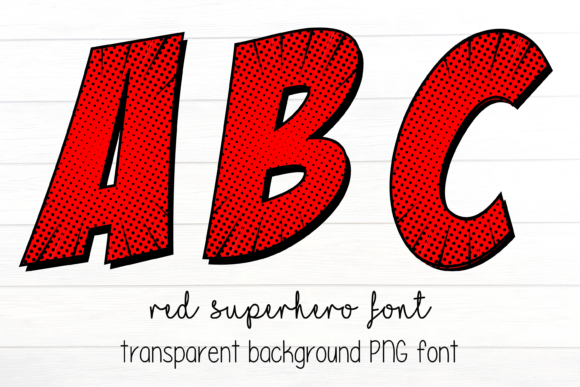
When sourcing typography for high-impact visual projects, professionals often encounter a choice between traditional installable typefaces and standalone graphic assets. The Red Superhero Alphabet PNG Letter Font represents the latter category, offering a distinct set of advantages and workflow considerations that differ significantly from standard OpenType or TrueType files. This resource is specifically engineered as a collection of mixed-case, high-resolution transparent PNG graphics rather than a font file you install into your operating system. Understanding this distinction is critical for designers, print-on-demand sellers, and content creators who need bold, thematic lettering without the technical overhead of font management.
The primary value proposition of this asset lies in its format. By utilizing individual PNG files for each character, users gain pixel-level control over placement, layering, and effects that can be cumbersome with live text. For projects requiring a comic book aesthetic, superhero branding, or energetic display headers, this mixed-case set provides immediate visual weight. However, because it functions as a series of images, it demands a different approach to composition and layout. Evaluating whether this tool fits your specific production pipeline requires looking at its resolution quality, versatility across print and digital mediums, and the practical realities of working with rasterized alphabet graphics.
Technical Specifications and Format Distinctions
It is imperative to clarify that the Red Superhero Alphabet PNG Letter Font is not an installable font. You cannot select it from a dropdown menu in Microsoft Word, Adobe Illustrator, or Cricut Design Space. Instead, it is a library of individual image files. Each letter exists as a separate high-resolution PNG with a transparent background. This architecture offers specific benefits for certain workflows while presenting limitations for others.
The mixed-case nature of this set is a significant functional detail. Many decorative display fonts only include uppercase glyphs, which can limit readability and design flexibility. Having access to both upper and lowercase variations allows for more natural word shapes and better typographic hierarchy. In a superhero or comic context, mixed case also mimics the hand-lettered style of vintage pulp covers and modern graphic novels more accurately than uniform block capitals. The transparency of the background ensures that these letters can be composited over any color, texture, or photograph without unsightly white boxes, provided the source files are properly masked.
Resolution and Print Readiness
For professional use, particularly in sublimation, Direct-to-Film (DTF), and print-on-demand applications, resolution is non-negotiable. Raster graphics like these must maintain crisp edges when scaled. When evaluating this asset, verify that the individual PNGs are sourced at 300 DPI or higher at their intended print size. High-quality superhero lettering relies on sharp contours and clean anti-aliasing; pixelation or jagged edges will immediately degrade the perceived value of merchandise or marketing materials. Because these are pre-rendered graphics, they bypass the rendering engine of design software, meaning what you see in the file preview is exactly what will output to the printer. This consistency is valuable for DTF printing where color accuracy and edge definition are paramount.
Practical Applications in Digital and Physical Media
The versatility of the Red Superhero Alphabet PNG Letter Font extends across multiple disciplines, but its utility is highest in projects where text is treated as a graphical element rather than body copy. The format excels in environments where speed and visual impact take precedence over editable text flow.
- Sublimation and DTF Transfers: The transparent background makes these letters ideal for apparel decoration. Users can arrange words directly in RIP software or design platforms like Canva and Photoshop without needing to create complex clipping masks. The bold red colorway is specifically optimized for visibility on light-colored garments and white substrates.
- Event Invitations and Stationery: For birthday parties, comic conventions, or themed events, this lettering style establishes tone instantly. The mixed-case format allows for readable names and dates, while the graphic nature of the PNGs permits easy integration with other illustrated elements like halftones, bursts, or character art.
- Social Media and Content Creation: Digital thumbnails, stream overlays, and promotional banners benefit from the pre-styled look of these letters. Since social media graphics are typically viewed at screen resolution, the PNG format loads quickly and displays consistently across devices without relying on web font loading or licensing restrictions.
- Merchandise Design: Stickers, mugs, and posters often require isolated lettering that interacts with product boundaries. Treating each letter as an independent object allows designers to wrap text around curves or conform to irregular print areas more intuitively than with constrained text boxes.
Workflow Considerations and Limitations
While the Red Superhero Alphabet PNG Letter Font offers creative freedom, it introduces friction in text-heavy workflows. Professionals must weigh these trade-offs against the aesthetic benefits. Because each character is a separate image file, typing out long paragraphs is impractical. This asset is strictly for display purposes—headlines, logos, short phrases, and single words. If your project requires extensive body text, this should be paired with a complementary, readable sans-serif or serif typeface installed on your system.
Kerning and leading must be adjusted manually. Unlike a programmed font file that includes metrics for automatic spacing, PNG letters require the designer to visually align each glyph. This grants ultimate control over ligatures and stylistic overlaps common in comic lettering, but it also increases production time. For users accustomed to typing and moving on, this manual assembly can feel tedious. However, for those who view lettering as illustration, this process is often preferred as it allows for custom adjustments that automated kerning tables cannot achieve.
Color editing presents another consideration. Since the letters are pre-colored red, changing the hue requires adjustment layers, blend modes, or recolorization tools within your design software. While this is straightforward in Photoshop or Affinity Photo, it may be limiting in simpler mobile apps or basic POD uploaders that lack advanced color correction features. Users planning to use this set in multiple colorways should test their recoloring workflow before committing to large-scale production.
Assessing Long-Term Value and Licensing
From a business perspective, owning a set of high-resolution PNG graphics offers a different ROI model than licensing a commercial font. Fonts often come with tiered pricing based on impression counts, end products, or company size. A static PNG set typically involves a one-time acquisition cost with broader usage rights for physical products, though users must always verify the specific license terms included with their purchase. For small business owners and freelancers producing limited-run merchandise or client-specific branding, this can be a cost-effective solution that avoids recurring subscription fees or complex commercial license negotiations.
Durability is also a factor. Unlike vector fonts that scale infinitely, PNGs have a fixed maximum size. Users should archive the original high-resolution masters and avoid repeatedly saving edited versions to prevent generational quality loss. Maintaining an organized folder structure with clear naming conventions is essential, as managing dozens of individual image files can become chaotic without proper digital asset management.
Determining Fit for Your Creative Needs
The Red Superhero Alphabet PNG Letter Font is best suited for creators who prioritize visual style over typographic automation. It serves a niche but vital role in the toolkit of marketers, educators, and designers working within pop culture, entertainment, and youth-oriented demographics. If your workflow frequently involves compositing, photo manipulation, or direct-to-garment printing where text needs to integrate seamlessly with raster imagery, this format aligns well with existing processes.
Conversely, publishers, editorial designers, or anyone producing text-dense documents will find this format inefficient. It is not a replacement for professional typesetting tools but rather a specialized supplement for moments requiring maximum visual energy. When evaluated objectively, its strength is not in versatility of application, but in excellence of execution within its specific domain. For the right project—a convention banner, a child’s birthday invitation, or a limited-edition t-shirt—the immediate impact and ease of layering offered by these mixed-case PNG graphics can justify the manual effort required to assemble them. Ultimately, the decision to utilize this resource should be driven by the specific demands of the deliverable and the technical comfort level of the creator in managing raster-based typography.