Reading Because Reality’s Overrated: Evaluating Aesthetic Bookish Designs for Merchandise and Personal Use
The phrase "Reading Because Reality’s Overrated" has evolved from a simple internet caption into a distinct visual subgenre within the book community. When paired with the tagline "Escape Reality, Enter a Good Book," this specific typographic design represents more than just a slogan; it is a curated aesthetic asset intended for print-on-demand products, personal crafting, and digital expression. For adults evaluating resources for book clubs, merchandise lines, or personal journaling, understanding the functional and stylistic distinctions of this design is essential before committing to a purchase or download.
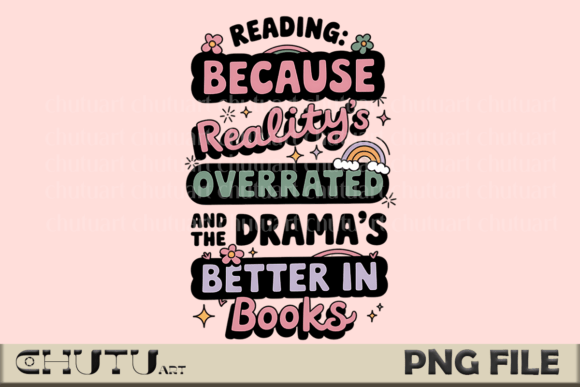
This design variant distinguishes itself through a deliberate combination of bold serif fonts, flowing script typography, and pastel iconography including stars, rainbows, and sparkles. Unlike minimalist text-only quotes or dark academia aesthetics, this style targets a specific demographic that values comfort, whimsy, and high-saturation positivity. When comparing options for bookish merchandise or creative projects, it is necessary to weigh how this specific aesthetic aligns with your intended use case against other available styles.
Distinguishing Features and Visual Hierarchy
When researching typographic assets, technical specifications and artistic composition are equally important. The "Reading Because Reality’s Overrated" design typically utilizes a mixed-font hierarchy that serves both legibility and emotional resonance. The primary statement often employs a bold, grounded typeface to anchor the message, while secondary phrases like "the drama’s better in books" utilize script fonts to introduce movement and softness.
This contrast is a critical decision factor. Purely script-based designs can be difficult to read on smaller items like bookmarks or stickers, while purely block-text designs may lack the playful tone required for cozy reading content. This hybrid approach offers a middle ground. Furthermore, the inclusion of hand-drawn style elements—sparkles and rainbows—adds texture that prevents the design from looking sterile when printed on fabric or paper. For users comparing this against generic stock vectors, the integrated nature of these illustrations means less post-editing work is required to make the composition feel cohesive.
Technical Specifications for Print and Digital Application
Evaluating the utility of this resource requires examining the file deliverables. High-quality iterations of this design are provided as 300 DPI PNG files with transparent backgrounds. This specification is the industry standard for professional printing and distinguishes viable commercial assets from low-resolution web graphics.
- Resolution Integrity: At 300 DPI, the design maintains crisp edges on sweatshirts and tote bags. Lower resolution alternatives (72–150 DPI) often result in pixelation or blurring when scaled up for apparel.
- Transparency Utility: A true transparent background allows for placement on colored fabrics without needing advanced masking skills. This is particularly relevant for pastel designs, where white bounding boxes would clash with garment colors.
- Color Profile Considerations: Pastel palettes can shift during the CMYK conversion process used in direct-to-garment printing. Users should verify if the provided PNG uses an RGB or CMYK color space to anticipate potential color variance.
Comparing Aesthetic Styles: Whimsical vs. Minimalist vs. Dark Academia
Selecting the right bookish design involves understanding where "Reading Because Reality’s Overrated" fits within the broader market of literary aesthetics. Each style serves different psychological needs and audience demographics.
Whimsical and Pastel (This Design): Best suited for readers who view fiction as a source of joy, safety, and escapism. The visual language communicates approachability and lightheartedness. It performs exceptionally well on items meant for daily comfort, such as mugs, journals, and casual wear. The tradeoff is that it may not resonate with readers who prefer serious literary analysis or darker genres like horror and thriller.
Minimalist Typography: Often featuring black text on white backgrounds with clean sans-serif fonts. This alternative appeals to modernists and those who want their merchandise to blend seamlessly with non-bookish fashion. While versatile, minimalist designs can sometimes lack the immediate emotional connection and community signaling that illustrative designs provide.
Dark Academia and Vintage: Characterized by muted earth tones, classical art references, and serif typography. This style targets readers interested in classics, history, and atmospheric settings. While highly popular, it carries a heavier, more serious tone. If the goal is to promote reading as a fun, stress-relieving hobby rather than an intellectual pursuit, dark academia may send the wrong message.
Evaluating Fit for Specific Merchandise Categories
The effectiveness of the "Reading Because Reality’s Overrated" design varies significantly depending on the physical medium. Practical evaluation suggests the following best-fit scenarios:
- T-Shirts and Sweatshirts: The pastel color palette works best on white, cream, or light gray garments. On dark fabrics, the design may require an underbase layer or modification to remain visible. The playful script elements translate well to the relaxed fit of sweatshirts.
- Tote Bags: Canvas totes absorb ink differently than synthetic blends. The bold elements of this design ensure readability even if the print texture is slightly rougher. The whimsical icons add visual interest to what is otherwise a utilitarian object.
- Stickers and Bookmarks: These smaller formats benefit most from the integrated illustration elements. A text-only quote can look sparse on a two-inch sticker, but the addition of stars and rainbows fills the negative space effectively without requiring additional design work.
- Mugs and Drinkware: The curved surface of a mug can distort wide designs. This particular layout, which often stacks text vertically or centrally, is generally safer for wraparound printing than horizontal landscape designs.
Tradeoffs and Limitations to Consider
While this design offers significant versatility, potential users must recognize its limitations to avoid mismatched expectations. The primary constraint is genre specificity. The phrase "Reality’s Overrated" inherently frames reading as escapism. This resonates deeply with fantasy, romance, and young adult fiction communities but may feel reductive to non-fiction readers or academic audiences. If you are creating merchandise for a diverse book club that includes biography and science readers, this design might alienate a portion of the membership.
Additionally, the trendy nature of pastel aesthetics and "cozy" vibes introduces a longevity consideration. Design trends cycle rapidly. While currently popular, highly stylized illustrative quotes can date a product faster than timeless typographic treatments. For users building a long-term brand identity, this design works best as part of a seasonal collection or a niche-specific line rather than a permanent logo or flagship image.
From a production standpoint, pastel colors present unique challenges in embroidery. If you intend to use this design for embroidered patches or hats, the intricate script and small sparkle details may not translate well to thread. Embroidery favors solid shapes and simpler lines. In such cases, this PNG asset would require significant simplification or redrawing, whereas it is ready-to-use for DTG (Direct-to-Garment) printing, sublimation, and vinyl cutting.
Decision Framework: When to Choose This Resource
Determining whether "Reading Because Reality’s Overrated" is the correct asset for your project depends on three core alignment factors: audience sentiment, application method, and customization capacity.
Choose this design if:
- Your target audience explicitly identifies with reading as self-care, comfort, or emotional regulation.
- You are utilizing print methods that support full-color, high-detail reproduction (DTG, sublimation, digital planning).
- You need a complete, pre-composed layout that minimizes design time and software requirements.
- The end product is intended for personal use, gifts, or niche community merchandising where trend relevance is valued over timelessness.
Seek an alternative if:
- Your audience prefers intellectual, serious, or genre-neutral messaging.
- You require a vector file (.SVG/.AI) for infinite scaling or extensive editing of individual elements.
- The intended application is embroidery, laser engraving, or single-color screen printing.
- You are building a corporate or institutional library brand where playful slang may undermine professional authority.
Maximizing Value Through Strategic Application
For those who determine this design is a strong fit, maximizing its value involves thoughtful implementation. Because the file is a high-DPI PNG with transparency, it offers flexibility in layering. Users can place the design over textured backgrounds in digital planners or combine it with photographic elements in social media posts without losing quality.
When using this for physical products, consider the emotional context of the item. A journal featuring this design signals a safe space for reflection and imagination. A t-shirt signals tribal belonging within the cozy reader community. Understanding these subtle signals helps in positioning the product effectively. Rather than simply selling a "book shirt," you are offering a tangible validation of the reader's desire to prioritize narrative over reality.
Ultimately, "Reading Because Reality’s Overrated" serves as a functional tool for expression within a specific cultural moment. By evaluating its technical specs, aesthetic positioning, and practical limitations against your specific needs, you can make an informed decision that balances creative appeal with functional viability. Whether for personal enjoyment or commercial creation, the right choice depends not just on liking the design, but on understanding how it performs in the real world of ink, fabric, and community expectation.