AI Asthma Monitoring App UI Kit: Design for Health
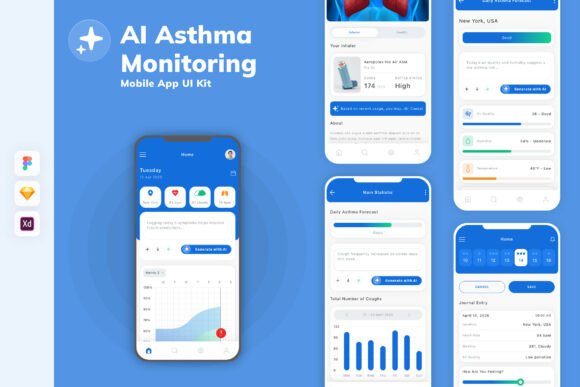
Designing for digital health requires a delicate balance between clinical accuracy and human empathy. When developing tools for respiratory care, the interface must be calming, intuitive, and immediately understandable during moments of distress. The AI Asthma Monitoring App UI Kit serves as a foundational resource for building these critical applications. It provides a comprehensive set of pre-designed screens and components specifically tailored for respiratory tracking, symptom logging, and AI-driven insights. Rather than starting from a blank canvas, designers and developers can leverage this kit to ensure their application meets the unique usability standards required for medical monitoring while maintaining a modern, clean aesthetic.
Diverse Perspectives on Digital Health Design
A single design resource holds different value depending on who is using it and why. A freelance designer might view this kit as a time-saver that allows them to take on specialized medical clients without needing years of niche experience. Conversely, a healthcare startup founder might see it as a risk-mitigation tool that ensures their minimum viable product looks professional enough to secure funding or user trust. Educators in UX programs may utilize it as a teaching aid to demonstrate how to visualize complex data like peak flow readings or air quality indices without overwhelming the user.
For hobbyists and students exploring the intersection of artificial intelligence and personal wellness, this kit offers a practical sandbox. It removes the barrier of creating medical iconography and layout structures from scratch, allowing learners to focus on the logic of AI integration and user flow. Small business owners operating in the telehealth space might prioritize the kit’s organizational structure, knowing that a well-named, layered file saves billable hours when iterating based on patient feedback. Understanding these varied motivations helps clarify whether this specific resource aligns with your current project goals and skill level.
Prioritizing Usability and Accessibility
In asthma management, clarity is not just an aesthetic preference; it is a safety requirement. Users experiencing breathing difficulties cannot navigate complex menus or decipher low-contrast text. This UI kit emphasizes a clean, elegant design philosophy that directly supports accessibility. The typography choices and spacing are optimized for readability, ensuring that critical alerts and daily logs are easily digestible. For professionals evaluating this kit, the primary metric should be how well the visual hierarchy guides a distressed user toward immediate relief or emergency contacts.
Beginners often struggle with establishing this level of visual discipline. By studying the included layouts, new designers can learn how to use whitespace effectively to reduce cognitive load. The kit demonstrates best practices for presenting AI-generated predictions—such as potential asthma triggers or medication reminders—in a way that feels supportive rather than alarming. This educational aspect transforms the template from a simple asset pack into a reference guide for empathetic health tech design.
Technical Flexibility Across Platforms
One of the most significant practical advantages of this AI Asthma Monitoring App UI Kit is its cross-platform compatibility. It has been carefully designed for Figma, Sketch, and Adobe XD, acknowledging that design teams operate within diverse ecosystems. Whether you are a solo creator committed to Adobe XD or an agency team collaborating in Figma, the source files are available and fully functional. This versatility prevents vendor lock-in and facilitates smoother handoffs between designers and developers who may prefer different tools.
The internal organization of these files deserves specific attention. Every element is fully layered and named accordingly, which drastically reduces friction during the customization phase. Experienced users know that poorly organized templates can sometimes take longer to fix than designing from scratch. Here, the logical grouping of components means you can download the template, change the text, add your images, and reach a polished state rapidly. This efficiency is vital for entrepreneurs working under tight deadlines or educators preparing course materials where setup time must be minimized.
Evaluating Quality and Customization Potential
When selecting a UI kit for medical applications, the depth of customization determines long-term usefulness. This kit includes free fonts and unique modern design elements that avoid the generic look often associated with stock templates. However, it is important to note that the photographs seen in the presentation are for demonstration purposes only and are not included in the design file. This distinction matters for budget planning; you will need to source appropriate, HIPAA-compliant imagery or create custom illustrations to complete the look.
For marketers and publishers, this separation of assets is actually beneficial. It allows for complete brand alignment without having to untangle embedded stock photos that might carry licensing restrictions. You retain full control over the visual narrative. Business owners should evaluate whether the included screen states cover their specific feature set. While the kit covers core asthma monitoring functions, niche features like insurance integration or multi-language support may require extending the existing design system. The robust foundation makes this extension feasible, but it requires honest assessment of your roadmap.
Matching the Resource to Your Goals
Determining if this AI Asthma Monitoring App UI Kit is right for you involves matching its strengths to your specific constraints. If your priority is speed-to-market for a prototype, the pre-built flows for symptom tracking and AI analysis provide an immediate head start. If your goal is learning, dissecting the component architecture offers valuable insights into scalable health app design. However, if you require a certified medical device interface with regulatory-compliant documentation, this kit should be viewed as a visual starting point rather than a final compliant solution.
- Freelancers and Agencies: Ideal for client pitches and rapid prototyping where visual fidelity builds confidence.
- Students and Educators: Excellent for case studies on data visualization and accessible interface patterns.
- Health Tech Startups: Useful for validating concepts with investors before committing to custom development costs.
- Content Creators: Provides high-quality visuals for articles, videos, or courses discussing AI in respiratory health.
Ultimately, the value of this kit lies in its ability to bridge the gap between technical AI capabilities and human-centered design. It handles the heavy lifting of layout and visual consistency, freeing you to focus on the nuances of user experience and clinical relevance. By providing well-organized, editable files across major design platforms, it respects the workflows of modern creative professionals. Whether you are building the next generation of respiratory care tools or simply exploring the possibilities of AI in health, this resource offers a structured, elegant foundation upon which to build meaningful digital experiences.